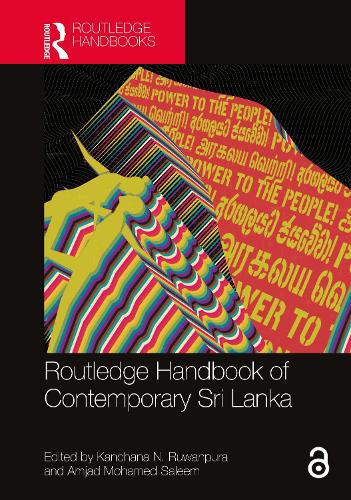
Routledge Handbook of Contemporary Sri Lanka
The Routledge Handbook of Contemporary Sri Lanka offers a comprehensive survey of issues facing the island country and an overview delineating some key moments in the country’s contemporary polity, economy, and sociality.
This book outlines aspects and influences foundational to understanding a country defined by its economic and political turmoil, and rift with public distrust in today’s shifting geopolitics. Chapters by various established scholars highlight this book’s pivotal contribution in situating Sri Lanka’s turmoil and deprivation in this current conjuncture.
The handbook is structured in seven parts:
- Nations and Nationalism
- Politics, State and Institutions
- Economy and Political Economy
- Work and Life
- Environment and Environmental Politics
- Society, Social Systems, and Culture
- Moment of Flux, Looking Ahead
Each part includes on average six chapters covering the social sciences and humanities to survey emerging and cutting-edge areas of the study of Sri Lanka. Multi-disciplinary in focus, the book also includes an introductory section and concluding section, which creates the space and platform for senior, mid-ranking, and junior academics to engage in dynamic conversation with each other about contemporary Sri Lanka. Including scholarship from Sri Lankan experts, the handbook creates academic output, which chimes with broader calls in academia on decolonising the academic landscape.
An important reference work, this handbook will be of interest to scholars and students from wideranging academic disciplines and a focus on Sri Lanka, Asian and South Asian studies, sociology, environmental politics, development, labour, management, political economy and anthropology.
The Open Access version of this book, available at http://www.taylorfrancis.com, has been made available under a Creative Commons Attribution-Non Commercial-No Derivatives (CC-BY-NC-ND) 4.0 license.
Product Information
Product Information
Shipping & Returns
Shipping & Returns
Description
The Routledge Handbook of Contemporary Sri Lanka offers a comprehensive survey of issues facing the island country and an overview delineating some key moments in the country’s contemporary polity, economy, and sociality.
This book outlines aspects and influences foundational to understanding a country defined by its economic and political turmoil, and rift with public distrust in today’s shifting geopolitics. Chapters by various established scholars highlight this book’s pivotal contribution in situating Sri Lanka’s turmoil and deprivation in this current conjuncture.
The handbook is structured in seven parts:
- Nations and Nationalism
- Politics, State and Institutions
- Economy and Political Economy
- Work and Life
- Environment and Environmental Politics
- Society, Social Systems, and Culture
- Moment of Flux, Looking Ahead
Each part includes on average six chapters covering the social sciences and humanities to survey emerging and cutting-edge areas of the study of Sri Lanka. Multi-disciplinary in focus, the book also includes an introductory section and concluding section, which creates the space and platform for senior, mid-ranking, and junior academics to engage in dynamic conversation with each other about contemporary Sri Lanka. Including scholarship from Sri Lankan experts, the handbook creates academic output, which chimes with broader calls in academia on decolonising the academic landscape.
An important reference work, this handbook will be of interest to scholars and students from wideranging academic disciplines and a focus on Sri Lanka, Asian and South Asian studies, sociology, environmental politics, development, labour, management, political economy and anthropology.
The Open Access version of this book, available at http://www.taylorfrancis.com, has been made available under a Creative Commons Attribution-Non Commercial-No Derivatives (CC-BY-NC-ND) 4.0 license.