
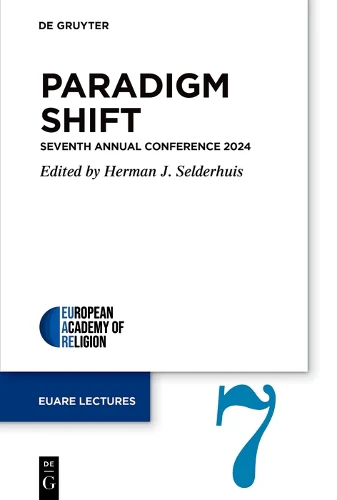
Paradigm Shift
This 7th volume in the series EUARE LECTURES contains the four keynote lectures presented at the European Academy of Religion’s Seventh Annual Conference held in Palermo, Italy, May 20-23, 2024 as it was organized by FSCIRE. The overarching theme of the conference was “Paradigm Shifts”, and four keynote lectures were invited to speak about the topic from their original point of view: Prof. Alberto Melloni (University of Modena and Reggio Emilia), Prof. Alexander Kulik (The Hebrew University of Jerusalem), Prof. Elisabeth Gräb-Schmidt (Eberhard Karls University of Tübingen), and Prof. Vincent Goossaert (Ecole Pratique des Hautes Etudes).
The expression “paradigm shift can be fruitfully applied to scholarship regarding religion to flesh out and highlight when and how the multiple disciplines of the broader field of religious studies found ways to change their own perspectives and the manner of defining, reading and analyzing the objects of their analyses. The lectures deal with paradigm shifts that result from the positive or conflictual engagement with major historical events, the use of innovative theoretical lenses, the adoption of brand new or established technologies or simply from renewed reading of religious sources often inspired by the results of academic research.
Product Information
Product Information
Shipping & Returns
Shipping & Returns
Description
This 7th volume in the series EUARE LECTURES contains the four keynote lectures presented at the European Academy of Religion’s Seventh Annual Conference held in Palermo, Italy, May 20-23, 2024 as it was organized by FSCIRE. The overarching theme of the conference was “Paradigm Shifts”, and four keynote lectures were invited to speak about the topic from their original point of view: Prof. Alberto Melloni (University of Modena and Reggio Emilia), Prof. Alexander Kulik (The Hebrew University of Jerusalem), Prof. Elisabeth Gräb-Schmidt (Eberhard Karls University of Tübingen), and Prof. Vincent Goossaert (Ecole Pratique des Hautes Etudes).
The expression “paradigm shift can be fruitfully applied to scholarship regarding religion to flesh out and highlight when and how the multiple disciplines of the broader field of religious studies found ways to change their own perspectives and the manner of defining, reading and analyzing the objects of their analyses. The lectures deal with paradigm shifts that result from the positive or conflictual engagement with major historical events, the use of innovative theoretical lenses, the adoption of brand new or established technologies or simply from renewed reading of religious sources often inspired by the results of academic research.